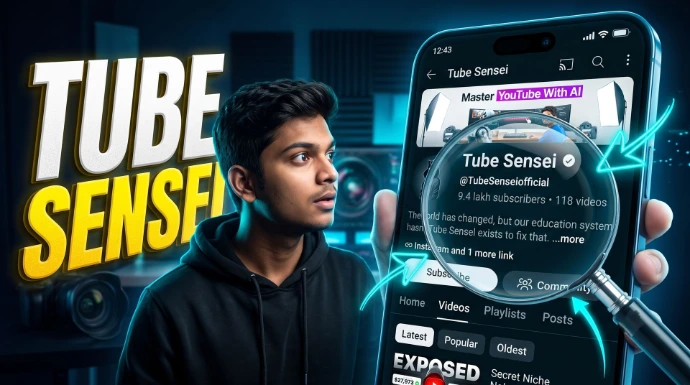
Tube Sensei is one of India's fastest-growing creator education and artificial intelligence tutorial channels, built and led by Chandigarh-based creator Praveen Kumar Shah. Launched on July 11, 2023, the channel has scaled to 940,000 subscribers and 66.28 million total views across just 118 long-form videos according to vidIQ. Starting with zero on-camera presence, an Oppo smartphone, and a 2D animated character avatar, Praveen turned Tube Sensei into a go-to learning hub for young creators who want to master mobile video editing, faceless YouTube automation, and AI content workflows.
What makes Praveen Kumar Shah's trajectory stand out is how deliberately he built Tube Sensei as a complete business rather than a simple AdSense channel. Across 118 uploads averaging over 20 minutes in length, Tube Sensei pulls an average of 559,500 views per video according to OutlierKit. By combining exhaustive full-course tutorials with global AI software sponsorships, his proprietary Sensei Academy learning portal, low-ticket digital editing bundles, and a 15-person production studio named VidCraft, Praveen transformed a single faceless channel into a multi-platform creator ecosystem.
From Praveen Kumar Shah's Early Failures to the Launch of Tube Sensei
Before Tube Sensei ever gained its first subscriber, Praveen spent three years testing and failing across Instagram and YouTube. Those early experiments shaped every content, editing, and monetization decision he later used to scale his flagship channel.
Praveen's Pre-Channel Crucible — Theme Pages, ₹50 Scripts, and Failed Channels (2020–2022)
What Tube Sensei Executed — Originally from Bihar and raised in Paonta Sahib, Himachal Pradesh, before moving to Chandigarh, Praveen started his online career during the September 2020 lockdown after dropping out of Allen Career Institute's medical entrance coaching and later leaving a Bachelor of Business Administration program in Landran, Punjab, as he shared in his Satish K Videos EXTRA Interview. His first breakthrough came on Instagram, where he built a business theme page called Billionaire Share past 30,000 followers—earning his first ₹3,000 in January 2021 and eventually closing four mentorship clients per month at Estimated Earning $85 to $145 (₹7,000 to ₹12,000 per client). Wanting to learn how YouTube channels held viewer attention without spending all day on sales calls, Praveen took a freelance scriptwriting job for an established movie-explanation YouTube channel at just ₹50 per two-hour movie script. Between 2021 and 2022, he also launched several experimental YouTube channels of his own, including a motivational Shorts channel (3 Into 4) that gained 60,000 subscribers across 30 uploads as disclosed in his 50K Special Q&A, a Western celebrity gossip channel, and a monetized movie-recap channel.
Why Praveen's Strategy Worked or Failed — Praveen's early YouTube channels hit a wall because they relied on shortcuts that violated YouTube's quality policies or clashed with his personal standards. When he tried converting his 60,000 Shorts subscribers on 3 Into 4 into long-form viewers using automated Pictory AI text-to-speech voiceovers, YouTube rejected the channel for monetization due to repetitive, robotic audio. While his English celebrity gossip and movie-explanation channels did get monetized, they depended on copyrighted clips and suggestive clickbait thumbnails that Praveen refused to show his family. Walking away from those channels forced him to rely on real skills he had mastered himself—mobile video editing, script framing, Facebook ad buying, and thumbnail design—which became the exact curriculum of Tube Sensei.
Actionable Frameworks for Creators
- Use Early Projects as Skill Incubators — Treat early theme pages or low-fee freelance scripting roles as paid training to master pacing, copyright rules, and audience retention before launching a flagship channel.
- Verify Monetization Compliance Early — Avoid building channels around robotic text-to-speech audio or unedited third-party clips that fail YouTube's partner review gate.
- Build Around Proud Brand Equity — Drop viral categories that require suggestive thumbnails or copyright loopholes so your flagship channel can attract legitimate brand sponsors.
The July 2023 Launch and Constructive Authority Piggybacking
What Tube Sensei Executed — On July 11, 2023, Praveen launched Tube Sensei—pairing YouTube with the Japanese word Sensei (teacher or master)—to teach aspiring creators the exact digital skills he had spent three years learning. Because he was camera-shy and worked on a tight budget, he recorded his own voiceovers at night, represented himself with an illustrated 2D anime character, and edited every video on an Oppo smartphone using CapCut. The channel crossed 50,000 subscribers within 90 days, hit 500,000 subscribers alongside Praveen's first on-camera face reveal in February 2025, passed 800,000 subscribers in early 2026, and reached 937,000 to 940,000 subscribers by October 2026. To drive initial views from zero subscribers, Praveen published technical breakdowns of India's top creators—including Dhruv Rathee, Manoj Dey, Algrow, and DecodingYT—led by his hit tutorial How To Edit Like @Dhruv Rathee On Phone (1.3 million views, 4.5× the channel median).
Why Praveen's Strategy Worked or Failed — A brand-new YouTube growth channel has zero built-in authority until it proves its expertise. Instead of attacking famous creators for drama clicks, Praveen used constructive authority piggybacking. By praising Dhruv Rathee's documentary framing and showing viewers step-by-step how to recreate those exact visual effects on a phone, Tube Sensei captured massive search traffic around established creator names while proving Praveen's own editing skill inside every frame.
Actionable Frameworks for Creators
- Execute Constructive Authority Piggybacking — Build early tutorials around the names and visual styles of top creators in your niche, showing viewers how to replicate their best techniques step by step.
- Anchor Faceless Channels with a Signature Avatar — Use a consistent 2D character or visual identity when starting off-camera so viewers immediately recognize your videos in their feed.
- Prove the Skill Inside the Video Edit — Let your own editing pace, sound design, and motion graphics demonstrate the exact quality you promise to teach.
Tube Sensei's Content Strategy, Packaging, and Retention Mechanics
Unlike creators who upload daily videos or flood their channels with Shorts, Praveen runs Tube Sensei on a low-frequency, high-impact long-form strategy. Across 117 analyzed uploads on OutlierKit, Tube Sensei averages 559,500 views per video, 55,400 daily views over its 3.2-year history, and a 70× views-to-subscriber ratio, showing how consistently its tutorials reach non-subscribers.
The Full Course Evergreen Curriculum vs. Trendjacking
What Tube Sensei Executed — Praveen dedicates 100% of Tube Sensei's main channel uploads to long-form horizontal videos averaging 20 minutes and 44 seconds, keeping Shorts completely off the primary channel. OutlierKit data shows that 85% of Tube Sensei's catalog consists of evergreen tutorials while 15% covers urgent platform updates and creator trends. The channel's biggest breakout hits are exhaustive, multi-chapter courses—specifically How To Edit Like Pro | Basic to Advance Editing (11.0 million to 12.0 million views, 37.7× median performance) and How To Start A YouTube Channel In 2026 | FULL COURSE (7.6 million to 8.0 million views, 26× median performance). Even when Praveen's team finishes nine videos for Tube Sensei in a single month, he caps publishing at 0.7 to 1.5 videos per week (roughly 3.2 to 6 uploads per month) as he explained in his 800K Special Q&A.
Why Praveen's Strategy Worked or Failed — Short five-minute tutorials rarely build lasting authority because beginners still have to search for five other videos to finish setting up their channel. By combining every step—niche research, channel setup, AI scriptwriting, mobile editing, thumbnail design, and monetization settings—into one 20-to-60-minute Full Course, Tube Sensei racks up massive watch time and repeat study sessions. Holding back excess uploads also protects viewer consumption bandwidth. As Praveen noted in his 800K Q&A, uploading every two days would overwhelm viewers who need time to practice a 25-minute technical tutorial, whereas spacing releases out keeps per-video views high for sponsors.
Actionable Frameworks for Creators
- Package Tutorials as A-to-Z Full Courses — Combine every beginner step of a workflow into one comprehensive, timestamped masterclass to dominate search results and maximize watch time.
- Separate Shorts Onto Secondary Channels — Keep vertical clips on dedicated side channels (like Tube Sensei Reels) so short-form viewers do not weaken long-form algorithmic recommendations.
- Control Upload Frequency Around Viewer Bandwidth — Space out dense 20+ minute tutorials so your audience has enough time to watch and apply each video before the next release drops.
Tube Sensei's Title Formulas and Faceless Thumbnail System
What Tube Sensei Executed — Across 117 uploads, Praveen organized Tube Sensei around six core topic pillars—AI Video Generation & Automation Workflows (32 videos), YouTube Growth Strategy & Algorithm Guides (28 videos), Video Editing & Production Tutorials (22 videos), Faceless Channel Ideas & Niche Breakdowns (16 videos), Alternative Online Income & Digital Products (11 videos), and Creator Case Studies (8 videos). Even after revealing his face at 500,000 subscribers, Praveen kept his face off 99% of Tube Sensei's thumbnails. Instead, his thumbnail designer Devesh crafts dark-mode, high-contrast visuals featuring software icons, earnings dashboards, before-and-after edits, or well-known creator faces. Praveen pairs those visuals with high-intent titles like How to make USA Based YouTube Channel (Real Method + Proof) (1.2 million views) and YouTube Automation with Free AI Tools | YouTube Automation Full Course (714,000 views), alongside periodic urgency hooks like Don't Start Youtube In 2024 (2.3 million views) and YouTube Will End Soon (611,000 views).
Why Praveen's Strategy Worked or Failed — When a viewer searches for an editing or AI tutorial, seeing a clear before-and-after graphic or software logo drives far more clicks than a creator's selfie. Keeping Tube Sensei's thumbnails focused on visual outcomes and tool interfaces allows the channel to convert cold viewers who have never heard of Praveen. Meanwhile, mixing practical earning guides with occasional policy warning hooks triggers both ambition and loss aversion among active creators.
Actionable Frameworks for Creators
- Use Tube Sensei's Four-Part Title Structure — Combine an Action Verb (How To Start / Make / Use) + Clear Creator Outcome (USA Based YouTube Channel / Video Editing) + Year or Free-Tool Hook (In 2026 / With Free AI Tools) + Proof Bracket (FULL COURSE / Real Method + Proof).
- Center Thumbnails on Outcomes Instead of Faces — Use high-contrast tool logos, revenue proof, or before-and-after graphics rather than personal headshots to win clicks from cold browse traffic.
- Use Urgency Warnings Sparingly — Reserve loss-aversion policy alerts for roughly 15% of uploads to re-activate quiet subscribers while dedicating 85% of your catalog to evergreen execution.
Shifting Tube Sensei from Slide Theory to Live AI Workflow Documentation
What Tube Sensei Executed — After upgrading his personal workflow in 2025 and 2026 from an Oppo phone to a 16-inch MacBook M4 Pro alongside lead editor Yash, Praveen evolved Tube Sensei's format from scripted avatar explainers to live screen-recorded documentation and unscripted podcasts. Recent uploads walk viewers live through building projects inside Anthropic's Claude, HeyGen, ElevenLabs, Higgsfield AI Cinema Studio, and Artlist.io, paired with unscripted creator roundtables alongside collaborators like Devesh Sharma and Tarun Bindlish.
Why Praveen's Strategy Worked or Failed — In his 800K Special Q&A, Praveen explained why he is phasing out basic informational talking-head videos—viewers can already get generic growth tips from ChatGPT in seconds, so pure information is losing value. What viewers cannot get from a chatbot is live documentation and real-time proof. Watching Praveen clone his voice, generate a cinematic AI commercial, or build an app inside Claude live on screen builds immediate credibility and keeps viewers locked in through 20-minute tutorials.
Actionable Frameworks for Creators
- Show Live Screen Execution Over Slide Summaries — Record the real software workspace, exact prompts, and live output on screen so viewers see every step working in real time.
- Reframe Tutorials as First-Person Documentation — Shift video concepts from generic advice (How to get 100K subscribers) to documented proof (How I monetized a new channel in 30 days).
- Apply Movie-Style Framing to Educational Scripts — Use Praveen's cinema-inspired scripting approach by structuring tutorials from zero to advanced so every chapter resolves one clear obstacle.
Tube Sensei's Audience Demographics and Multi-Platform Community Moat
Tube Sensei's rapid growth stems from how closely Praveen tailored his tutorials to the daily reality, hardware limits, and income goals of his core viewers.
Serving the Mobile-First South Asian Student-Hustler
What Tube Sensei Executed — OutlierKit's demographic analysis shows that Tube Sensei's audience is 85% male and 15% female, concentrated in the 18–24 age bracket (55%), followed by 25–34 (30%) and 13–17 (15%). Geographically, 79% of viewers watch from India, 11% from Pakistan, 5% from Bangladesh, and 5% from the United States. Instead of teaching desktop-heavy workflows that require expensive computers or paid software, Praveen centered Tube Sensei around mobile editing apps (CapCut, Alight Motion), free AI tool tiers, and faceless US-targeted channel blueprints that help South Asian creators earn $12 to $15 US RPMs.
Why Praveen's Strategy Worked or Failed — Tube Sensei's core viewer is a college or high school student from a middle-class household who wants to earn independently without asking parents for money—the exact position Praveen was in when he wanted pocket money for street food in 2020. Because these viewers rarely own high-end PCs, feel shy recording on camera around family, and face sub-$1.00 local AdSense RPMs, Praveen's mobile-first, faceless, US-arbitrage tutorials solve their three biggest bottlenecks at once.
Actionable Frameworks for Creators
- Design Tutorials Around Your Audience's Actual Hardware — Teach mobile apps and free software workflows when serving student audiences instead of assuming viewers own expensive desktop rigs.
- Show Viewers How to Capture High-RPM Markets — Teach creators in low-RPM regions how to produce English-language or globally relevant faceless content that earns Western ad rates.
- Provide Complete Off-Camera Workflows — Give camera-shy beginners end-to-end voiceover, avatar, and screen-recording systems so they can launch channels immediately.
The YouTube-to-Telegram-to-Instagram Retention Funnel
What Tube Sensei Executed — To build direct reach outside YouTube's algorithm, Praveen connected Tube Sensei to the Tube Sensei Telegram broadcast channel (135,170 to 136,000 subscribers, managed by admin @AditoYT) and his official Instagram account (@tubesensei). Whenever Praveen drops a YouTube tutorial, he points viewers to his Telegram channel to grab the exact companion resources used in the video—including Claude prompt PDFs, 15-category Mega Editing Packs, anime motion overlays, and Google Drive folders containing viral sound effects—driving 110,000 to 228,000 views per Telegram post. He also runs ₹1,000 per-video comment giveaways on YouTube, announcing the randomly selected winners on his Instagram Stories and Instagram community channel to keep recent upload engagement at 3.9%.
Why Praveen's Strategy Worked or Failed — Offering free editing packs and prompt sheets on Telegram converts one-time YouTube viewers into a massive owned community of over 135,000 subscribers who get instant notifications for every new video and course launch. Meanwhile, the ₹1,000 comment giveaway sparks thousands of comments within hours of upload while moving YouTube viewers over to Instagram. The main vulnerability in this setup is third-party admin oversight—allowing Telegram admin @AditoYT to post modified third-party software APKs alongside official video links and course piracy warnings drives raw downloads from students, but creates brand-safety risks with enterprise software sponsors.
Actionable Frameworks for Creators
- Lock Free Companion Files Inside an Owned Broadcast Channel — Host your video prompt sheets, SFX folders, and project templates on Telegram, Discord, or an email list to turn casual viewers into permanent community members.
- Use Micro-Giveaways to Drive Cross-Platform Traffic — Run small per-video comment giveaways and announce winners on Instagram Stories to boost YouTube comment velocity and grow your secondary social profiles.
- Maintain Direct Editorial Control Over Community Channels — Keep community broadcast feeds strictly limited to proprietary assets and official links so third-party admins never post files that could jeopardize brand partnerships.
Tube Sensei's Monetization Architecture and VidCraft Studio
Because Hindi-language educational videos earn less than $1.00 per thousand views in AdSense, Praveen built a four-part monetization engine around Tube Sensei that turns modest ad payouts into a multi-channel media business.
Praveen's 20/80 AdSense-to-Sponsorship Revenue Model
What Tube Sensei Executed — Third-party analytics platforms model Tube Sensei's baseline YouTube ad revenue at Estimated Earning $439 to $617 per month (Estimated Earning $571 to $2,000 per month including baseline integrations) with a channel asset valuation of Estimated Earning $9,934 to $50,394 on OutlierKit, while vidIQ estimates Estimated Earning $1,438 per month (Estimated Earning $360 per video). In his own primary disclosures during his 800K Special Q&A and Satish K Videos EXTRA interview, Praveen opened his actual books—confirming that with an Indian RPM under $1.00, Tube Sensei earned Estimated Earning $20,000 in total AdSense across its first two years and Estimated Earning $17,547 in full-year 2025 AdSense. More importantly, Praveen revealed that AdSense accounts for only 20% of Tube Sensei's revenue, while 80% comes from international brand sponsorships. Through an independent remote sponsorship manager from eastern India whom Praveen started working with when the manager was in 12th grade, Tube Sensei skips domestic brands to partner almost exclusively with global AI and SaaS companies—including vidIQ, HeyGen, ElevenLabs, Higgsfield AI, and Artlist.io—landing up to Estimated Earning $8,300 (₹7,00,000) for a single dedicated AI avatar cloning video.
Why Praveen's Strategy Worked or Failed — International AI software brands gladly pay premium rates to reach Tube Sensei's audience because every viewer is an active or aspiring creator looking for editing, voiceover, and automation tools. Praveen protects this sponsorship engine by deliberately picking broad, high-demand video topics (How To Start A YouTube Channel, AI Masterclasses) that keep his rolling average view count near 559,500 views per upload. Furthermore, his sponsorship deals combine three revenue layers at once—an upfront flat production fee, recurring affiliate commissions from description links, and multi-video retainers.
Actionable Frameworks for Creators
- Align Tutorials with Global SaaS Sponsors — Build content around software tools and digital workflows so international B2B companies pay high customer-acquisition sponsorship rates regardless of local AdSense RPMs.
- Optimize Topic Selection to Protect Average Views — Frame deep technical lessons inside broad beginner hooks so your average view count per video stays high enough to command premium sponsorship quotes.
- Negotiate Three-Part Hybrid Brand Deals — Structure software sponsorships around an upfront fee, an affiliate revenue-share link, and long-term multi-video packages.
Sensei Academy, Digital Asset Bundles, and the 15-Person VidCraft Team
What Tube Sensei Executed — Beyond brand deals, Praveen monetizes his ecosystem through Sensei Academy, his custom learning platform built on Classplus, along with affordable digital asset bundles. On Sensei Academy, Praveen offers free starter courses (Instagram Theme Page Business, How To Use ChatGPT, How To Start A YouTube Channel, and Edit Like A Pro) before upselling paid cohorts such as his 10-module Zero To Hero – Mobile Editing Course (which teaches Alight Motion, 3D cameras, and Dhruv Rathee / Iman Gadzhi / Tube Sensei editing styles, and connects the top 10 editors from every batch directly with YouTubers for paid freelance work) and ₹500 to ₹3,490 digital product and PSD thumbnail bundles built with his designer Devesh. In January 2026, Praveen disclosed earning Estimated Earning $9,500 (over ₹8,00,000) in passive revenue from selling digital product bundles alone. Praveen reinvests these profits into VidCraft, his Chandigarh-area media production company where he employs 15 young team members (10 in-office staff and 5 remote contributors aged 17 to 24, earning between ₹15,000 and five figures monthly). Through VidCraft, Praveen operates multiple channels simultaneously—including his personal channel Praveen Kumar, Tube Sensei Reels, Praveen Finance (an automated finance Shorts channel hosted by an AI clone of Praveen), and undisclosed English-language automation channels.
Why Praveen's Strategy Worked or Failed — As Praveen shared in his 800K Special Q&A, growing from 500,000 to 800,000 subscribers taught him that scaling past half a million subscribers is no longer a content problem—it is a business management problem. By re-reading The E-Myth Revisited and building Standard Operating Procedures (SOPs) for his 15-person VidCraft team, he removed himself from daily editing bottlenecks and turned Tube Sensei into a cash-flow engine that funds automated English and finance channels. Meanwhile, pricing digital asset bundles at ₹500 makes them an easy impulse purchase for Indian students while generating near-pure profit.
Actionable Frameworks for Creators
- Pair Free Lead-Magnet Courses with Career-Focused Paid Cohorts — Offer free foundational courses on your own platform to build trust, then upsell advanced skill cohorts that connect top students with real freelance clients.
- Sell Low-Ticket Digital Asset Packs for High-Margin Volume — Package the exact PSD templates, SFX libraries, and editing presets your team uses into affordable ₹500 ($6) bundles for your audience.
- Reinvest Flagship Channel Profits into an SOP-Driven Studio — Use sponsorship income from your main educational channel to hire a dedicated production team and build automated channels in high-RPM niches like finance and English infotainment.
Tube Sensei's Structural Risks and Future Roadmap (2026–2030)
As Tube Sensei approaches the one-million-subscriber milestone and Praveen targets a $1 million annual revenue goal, his operation highlights three critical risks that every creator in the AI and growth space must manage.
Managing YouTube Policy Bugs, Format Replicability, and AI Shifts
What Tube Sensei Executed — During late 2025 and early 2026, Praveen navigated two major operational challenges. First, a three-month hiatus in late 2025 caused Tube Sensei's monthly views to dip from over 2 million to under 1 million—a slump he reversed in January 2026 by publishing six Tube Sensei videos, three Praveen Kumar videos, and 10+ Praveen Finance Shorts in a single month to push monthly views back to 2.1 million to 2.96 million. Second, Tube Sensei was hit by automated YouTube policy enforcement bugs. In his Satish K Videos EXTRA interview, Praveen revealed that YouTube's automated moderation systems wrongly deleted and demonetized several of his uploads under Harmful and Dangerous Content flags—including tutorials with money graphics on thumbnails and a harmless guide on finding news stories for news vlogs—requiring public appeals on X (formerly Twitter) to restore them.
Why Praveen's Strategy Worked or Failed — OutlierKit rates Tube Sensei's format as having High Replicability, since screen-recorded software tutorials and structured slide explainers can be copied by rival production teams. At the same time, channels teaching AI automation and online income face constant platform policy tightening and rapid tutorial obsolescence whenever AI tools change their pricing. Praveen's response—putting his real face and personality front and center in Q&As, podcasts, and vlogs while automating VidCraft's multi-channel portfolio so he can eventually expand into businesses outside YouTube—directly insulates his career from single-channel dependency.
Actionable Frameworks for Creators
- Audit Thumbnails and Titles Against Automated Moderation Filters — Keep heavy cash graphics and exaggerated income phrases out of thumbnails and titles to avoid triggering automated platform takedowns.
- Transition From Faceless Tutorials to Founder-Led Authority — Gradually introduce on-camera podcasts, live demos, and personal Q&As alongside screen-recorded tutorials so competitors cannot clone your brand identity.
- Use Flagship Channels to Fund Off-Platform Businesses — Build SOP-driven production teams and owned educational platforms early so your income survives any single algorithm shift or platform policy update.